
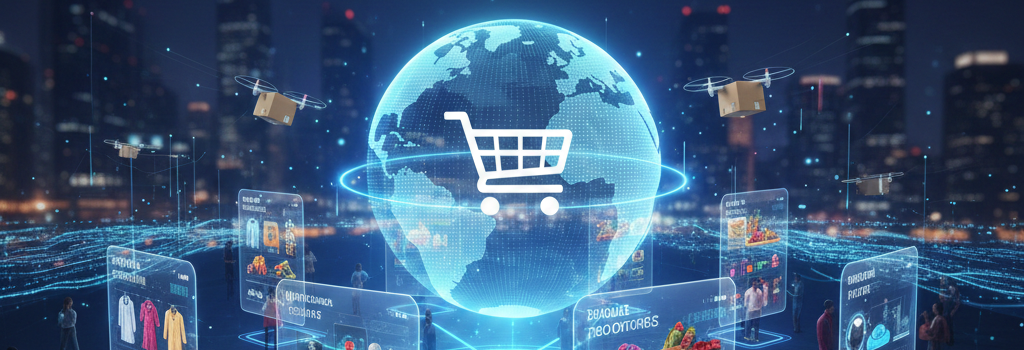
What Is E-Commerce?
E-commerce, short for electronic commerce, means buying and selling products or services using the internet. Today, e-commerce is not just a trend—it has become a normal part of daily life. From ordering groceries and clothes to booking tickets and paying bills, everything can be done online.
In simple words, if you buy or sell anything using a website, mobile app, or online platform, that activity is called e-commerce.
Meaning of E-Commerce
E-commerce is the process of doing business digitally. It includes:
- Online shopping
- Online payments
- Digital marketing
- Order management
- Online customer support
Example:
When you order a mobile phone from Amazon, pay using UPI, and get it delivered to your home—that is e-commerce.
History of E-Commerce
E-commerce started in the 1990s when the internet became public. At first, only big companies used it. Slowly, with better internet, smartphones, and digital payments, e-commerce became popular among common people.
Big platforms like Amazon, eBay, and Alibaba changed the way people shop. In India, Flipkart, Meesho, Myntra, and Amazon India made online shopping easy even in small towns.
Types of E-Commerce
There are different types of e-commerce based on who is buying and selling.
1. B2C (Business to Customer)
This is the most common type.
Businesses sell directly to customers.
Example:
- Amazon
- Flipkart
- Myntra
2. B2B (Business to Business)
One business sells to another business.
Example:
Wholesale websites
Software companies selling to offices
3. C2C (Customer to Customer)
One customer sells to another customer.
Example:
- eBay
- OLX
4. C2B (Customer to Business)
Customers sell their service or product to businesses.
Example:
- Freelancers on Fiverr or Upwork
- Photographers selling photos to companies
How E-Commerce Works
The basic process of e-commerce is:
- Customer visits a website or app
- Selects product or service
- Adds to cart
- Makes payment
- Seller processes the order
- Product is shipped
- Customer receives the product
All this happens with the help of:
- Website or app
- Payment gateway
- Delivery service
- Customer support system
Benefits of E-Commerce
1. Easy Shopping
You can shop anytime, anywhere. No need to go to a shop.
2. Saves Time
No travel, no long lines, no waiting.
3. More Choices
Online stores offer thousands of products.
4. Better Prices
You can compare prices easily and get discounts.
5. Global Reach
A seller in India can sell to customers in other countries.
Advantages for Business Owners
- Low starting cost
- No need for big shop or showroom
- 24/7 business open
- Easy to scale business
- Direct customer data
- Better marketing through ads and social media
Disadvantages of E-Commerce
For Customers:
- Cannot touch or try products
- Delivery takes time
- Risk of fake products
- Online fraud or scams
For Sellers:
- High competition
- Technical problems
- Need for digital skills
- Dependence on delivery services
Popular E-Commerce Platforms
Some famous e-commerce platforms are:
- Amazon
- Flipkart
- Meesho
- Myntra
- Ajio
- Shopify
- WooCommerce
Shopify and WooCommerce help people create their own online store.
What Is an Online Store?
An online store is a website where a business sells products or services. It has:
- Product pages
- Shopping cart
- Payment system
- Order tracking
- Customer support
You can build an online store using:
- Shopify
- WordPress + WooCommerce
- OpenCart
- Magento
Payment Methods in E-Commerce
E-commerce uses many digital payment methods:
- UPI
- Debit/Credit Card
- Net Banking
- Wallets (Paytm, PhonePe, Google Pay)
- Cash on Delivery
Safe payment systems are very important for trust.
Delivery and Logistics
After order, product must reach the customer. This is called logistics.
It includes:
- Packaging
- Shipping
- Tracking
- Delivery
- Return handling
Courier companies like Delhivery, Blue Dart, Ekart, and India Post support e-commerce.
E-Commerce and Digital Marketing
Without marketing, no one will know your store. E-commerce uses:
- Google Ads
- Facebook and Instagram Ads
- SEO (Search Engine Optimization)
- Email marketing
- WhatsApp marketing
SEO helps your website rank on Google. Ads help you get fast customers.
What Is SEO in E-Commerce?
SEO means optimizing your website so it appears on Google when people search.
Example:
If someone searches “buy shoes online” and your website shows on page 1, that is SEO success.
SEO includes:
- Good content
- Right keywords
- Fast website
- Mobile friendly design
- Good product descriptions
Role of Google Ads in E-Commerce
Google Ads helps e-commerce businesses show ads when people search for products.
Example:
If someone searches “best mobile under 15000”, your ad can appear on top.
Benefits of Google Ads:
- Fast sales
- Target right customers
- Control budget
- Measure results
E-Commerce in India
E-commerce in India is growing very fast. Small towns and villages are also shopping online now.
Reasons:
- Cheap smartphones
- Internet availability
- UPI and digital payments
- Trust in online platforms
Many people now start online business from home.
How to Start an E-Commerce Business
Step 1: Choose Product
Decide what you want to sell.
Step 2: Choose Platform
Use Shopify, WooCommerce, or marketplace.
Step 3: Register Business
Get GST and bank account.
Step 4: Add Products
Upload photos, price, description.
Step 5: Set Payment and Delivery
Connect payment gateway and courier.
Step 6: Do Marketing
Run ads and use social media.
Future of E-Commerce
The future of e-commerce is very bright. New technologies like:
- AI
- Voice shopping
- AR/VR
- Faster delivery
- Smart recommendations
will make online shopping even easier.
People will buy more online than offline in coming years.
E-commerce is the modern way of doing business. It has changed how people buy and sell products. With internet, smartphones, and digital payments, e-commerce is growing every day.
For customers, it means easy and fast shopping.
For business owners, it means big opportunity with low investment.
If you want to start a business in 2026, e-commerce is one of the best choices. With the right product, good service, SEO, and Google Ads, anyone can build a successful online business.
E-commerce is not just business—it is the future of shopping.
